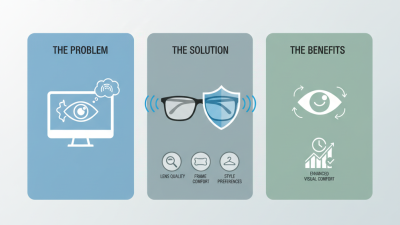
So, a photochromic blue cut lens basically gives you two things in one—whether you need a prescription or not. The photochromic part? That’s the magic that darkens when UV hits it, and then it usually fades back to clear once you’re indoors. Meanwhile, the blue-light filtering bit helps block out some of that visible blue light, though exactly how much depends on the lens design. Honestly, it’s pretty practical: you can wear one pair for a sunny stroll outside and still use them for screen time all day. That said, results can vary quite a bit—temperature, how much sun you’re getting, and even the glass in your car can all change how they behave.
Look, industry research can definitely explain why everyone's talking about blue light glasses. But it's a big stretch to treat that as proof they actually work medically. The Vision Council's 2023 Focused inSights: Digital Habits report, for instance, digs into people's screen habits and how they experience digital eye strain. It's helpful for understanding the demand, sure, but it's not evidence that filtering blue light will stop eye disease. And the 2023 Cochrane review on blue-light-filtering lenses? It found that any short-term relief for eyestrain was, at best, uncertain. So there's a gap between the buzz and the proven benefit. That distinction is easy to miss, honestly. A Blue Cut With Photochromic Lens might make things a little more comfortable or convenient for some people, but it’s not going to replace an accurate prescription or sensible screen breaks. So when you talk to an optician, ask about the real-world details — how quickly does the lens darken, does it stay clear indoors, and will it even activate behind a car windshield? Because small details matter more than you’d think. Honestly, don’t get too hung up on the brand or the label. What really matters is how the lens actually performs—and whether it fits your own needs.

What Defines a Photochromic Blue-Cut Lens?
A Photochromic And Blue Cut Lens combines two different optical functions. Its photochromic molecules darken when exposed to ultraviolet radiation, then fade indoors. The blue-cut component selectively reduces some short-wavelength visible light. It does not necessarily block all blue light. The exact effect depends on the lens material, coating, and wavelength range; a transmission curve is more informative than the label alone.
Look closely at the specifications. Ask how much visible light passes through the lens in its clear and darkened states, and what wavelengths the blue-cut filter targets. Temperature and limited UV exposure behind a vehicle windshield can affect darkening. That can make real-world performance less predictable than a simple product description suggests. Small detail, big difference.
Evidence also deserves a careful reading. A 2023 Cochrane review examined 17 randomized trials involving 619 adults. It found that blue-light-filtering spectacle lenses may not reduce short-term computer-related eye strain compared with regular lenses. This does not test every photochromic blue-cut design, but it cautions against assuming the filter prevents discomfort. The lens can still offer useful brightness adaptation outdoors; fit, prescription accuracy, and individual comfort matter too. The label sounds tidy. The experience may not be.
Blue Light Explained: The Commonly Cited 400–500 nm Range
Blue light is commonly described as visible light in the 400–500 nanometre range. The shortest wavelengths appear violet-blue; longer ones look more blue or cyan. This range is a useful reference, not a hard boundary used identically by every lens maker or researcher. Light does not stop being blue at one exact number.
A blue-cut lens reduces some light within a selected wavelength band. The amount and range filtered depend on the lens design, so “blue cut” alone does not reveal how much light passes through. Check the product’s measured transmission data when available. A yellow tint may suggest stronger filtering, but appearance is not a precise measurement.
A photochromic blue-cut lens combines this filtering with a lens that darkens in response to light. Many photochromic materials react mainly to ultraviolet light, while some designs also respond to short-wavelength visible light. The change can be subtle indoors and more noticeable outside. It varies with sunlight, temperature, and the windshield or window between the wearer and the sun. Details matter.
The 400–500 nm range is often discussed because screens and daylight contain light in this region. But blue light is not automatically harmful, and filtering it does not guarantee relief from eye strain. Screen breaks and comfortable lighting still matter. The label can sound more exact than it is.
Photochromic Chemistry: How UV and Visible Light Trigger Darkening
What Is a Photochromic Blue Cut Lens?
Photochromic Chemistry: How UV and Visible Light Trigger Darkening
Photochromic lenses contain light-sensitive molecules, often based on naphthopyran chemistry. UV exposure changes their molecular structure, creating forms that absorb more visible light. The lens darkens. Indoors, the reaction reverses and the lens gradually clears. It is a reversible chemical switch, not a simple coating that “senses” brightness.
UV and visible light are different parts of the spectrum, though their standard ranges overlap slightly. The International Commission on Illumination places visible light at about 380–780 nanometres; UV spans about 100–400 nanometres. Some photochromic designs also respond to short-wave visible light, which can affect darkening behind glass. A blue-cut filter is a separate feature: photochromic darkening alone does not prove that a lens meaningfully filters blue light. The response also varies with temperature, lens material, and exposure. Real life is less tidy than a lab test. The WHO and WMO Global Solar UV Index guide recommends protection at UV Index 3 or above; this is useful context, not a lens performance rating.
Tips: Check the lens maker’s measured transmission data, including UV and visible-light ranges. Test how quickly the lens clears indoors, too. Car windows can limit UV exposure, so some lenses may darken less in a vehicle.
What Is a Photochromic Blue Cut Lens? — Photochromic Chemistry: How UV and Visible Light Trigger Darkening
| Dimension |
What Happens |
Practical Significance |
| Photochromic lens |
A lens containing light-responsive molecules that reversibly change structure when exposed to activating light. |
The lens darkens in brighter conditions and generally becomes clearer again when the activating light is reduced. |
| Common photochromic chemistry |
Organic photochromic compounds can include naphthopyrans and spirooxazines. The precise chemistry depends on the lens design. |
Different compounds and lens constructions can produce different activation ranges, darkening levels, and fading behavior. |
| UV trigger |
Ultraviolet A (UVA) light, approximately 315–400 nm, can initiate a molecular change that creates a more light-absorbing form. |
UV exposure is an important trigger for many photochromic lenses. Behind a vehicle windshield, activation may be reduced because windshield glass blocks much of the incoming UV. |
| Visible-light trigger |
Some photochromic formulations also respond to selected parts of the visible spectrum. Sensitivity varies with the chemistry. |
Visible-light responsiveness can support darkening in situations where UV exposure is limited, but it is not the same as universal activation by all visible light. |
| Molecular darkening |
After activation, the photochromic molecule shifts into a form that absorbs more visible light. The population of this form increases while activating light is present. |
Greater absorption makes the lens appear darker. The resulting tint depends on the molecule, concentration, lens material, temperature, and light conditions. |
| Fading back |
When activating light decreases, the molecules gradually return toward their less-absorbing state. This is a reversible process. |
Clearing is not necessarily instantaneous. Fade time varies with the formulation, temperature, lens construction, and exposure history. |
| Blue-light filtering |
“Blue cut” describes filtering or reducing some short-wavelength visible light, often in the blue-violet region. Photochromic darkening is a separate light-responsive function. |
A lens being photochromic does not, by itself, establish how much blue light it filters. Blue-light transmission depends on the lens’s spectral design and whether it is in its clear or activated state. |
| UV protection |
UV protection is a distinct performance characteristic that depends on the lens material and its UV-absorbing design. |
Visible darkening alone cannot be used to determine UV protection. Check the lens’s stated UV transmission or protection specification. |
| Factors affecting performance |
Activation and fading can be influenced by UV and visible-light intensity, temperature, lens thickness, material, and the photochromic formulation. |
Appearance and response can differ between indoor and outdoor settings and across weather conditions. Performance should be assessed using the specific lens specification. |
Important distinction: Photochromic describes a reversible response to light; blue-cut describes spectral filtering. A lens can combine both features, but one does not automatically imply the other.
Blue-Cut Performance: Compare Spectral Transmittance Across 400–500 nm
A photochromic blue-cut lens combines two functions: it darkens under certain light conditions and alters how much visible light passes through. The key comparison is its spectral transmittance from 400 to 500 nanometers. This region spans violet and blue light, so a single “blue-cut” percentage can hide important differences. A spectrophotometer measures the amount transmitted at each wavelength. The resulting curve shows whether filtering is broad or concentrated in a narrow band. Small differences matter. For example, two lenses may transmit similar amounts at 450 nm but differ considerably near 420 or 490 nm.
Photochromic performance can change the curve. The lens may transmit more light indoors, then darken outdoors as it responds to ultraviolet radiation; temperature and test conditions can also affect results. Compare measurements taken in clearly stated conditions, including whether the lens was activated and how long it was exposed. A neat curve is useful, but it does not establish a health benefit by itself. Nor does one reading describe every wearer’s experience. I would not treat one attractive curve as a complete verdict. The fuller picture includes visible-light transmission, color appearance, and how consistently the lens changes between settings. Actual results vary by lens design.
Lens Transmittance Testing: The Scope of ISO 8980-3
A Blue Cut Photochromic Lens combines selective light filtering with a tint that changes as illumination shifts. The tint may look darker outdoors, but appearance alone cannot show how much light passes through. Not enough.
ISO 8980-3:2022 sets transmittance specifications and test methods for uncut finished spectacle lenses. Testing looks at spectral transmission, helping labs assess how a lens handles light across wavelengths rather than relying on one headline percentage. For photochromic lenses, results should identify the lens state and test conditions; otherwise, two figures may not be comparable. The standard does not, by itself, prove a lens blocks every form of blue light. CIE’s S 026/E:2018 framework also shows why wavelength-specific measurements matter: light’s biological effects are not captured by a single broad “blue” label. A useful, but imperfect, shortcut is to ask for the measured spectrum and the method used.
Tips: Check whether transmittance data are reported for both light and dark states. WHO’s Global Solar UV Index guide recommends sun protection at UVI 3 or above, but the index describes outdoor UV conditions, not lens performance. Ask for the lens’s UV-transmittance test results too. Small details matter.
Sunglass Filter Categories: ISO 12312-1’s 0–4 Scale
What Is a Photochromic Blue Cut Lens?
Sunglass Filter Categories: ISO 12312-1’s 0–4 Scale
Sunglass filter categories describe visible-light transmission, not lens darkness by appearance alone. ISO 12312-1:2022 classifies filters by luminous transmittance: Category 0 transmits 80–100% of visible light; Category 1, 43–80%; Category 2, 18–43%; Category 3, 8–18%; and Category 4, 3–8%. These ranges help distinguish a light tint from a very dark filter. The CIE’s photometry standard explains the visible-light weighting used in such measurements. That detail matters.
For everyday outdoor glare, Categories 2 and 3 are common choices; Category 3 cuts more visible light. Category 4 is intended for very bright conditions, such as high mountains, and is not suitable for driving under ISO guidance. A Photochromic Blue Cut Lens may change its tint with exposure, but “blue cut” does not identify its ISO category or prove UV protection. Ask for test results showing the lens’s transmission and UV performance.
Photochromic lenses can respond differently with temperature, exposure, and behind a car windscreen. So a label alone may not tell you how dark the lens will feel outdoors. Still, the category is a useful starting point, not a complete comfort test. ISO 12312-1 sets the filter classifications; individual fit, glare, and intended use also matter.
Real-World Limits: Temperature, Activation Speed, and Residual Tint
A photochromic blue-cut lens combines selective blue-light filtering with molecules that darken under ultraviolet exposure. Its real-world behavior is less tidy than the product description suggests. Temperature matters: in cold weather, lenses often reach a deeper tint but may take longer to clear; in warmth, they usually remain lighter. A winter walk can therefore leave a faint gray cast indoors. It varies.
Activation also takes time. The lens does not switch instantly when you step outside or enter a car. Windscreens block much of the UV that triggers many photochromic materials, so the tint may stay modest while driving. ISO 12312-1:2022 classifies sunglass filters by visible-light transmission: Category 0 transmits over 80%, while Category 3 transmits 8–18%. Those figures describe filter darkness, not how quickly a lens changes. Blue Cut Lens For Night Driving should not be read as a promise of better night vision; any remaining tint can reduce light reaching the eye.
Residual tint is easy to miss in bright conditions and more noticeable beside a white screen or under indoor lighting. Ask an optician to assess the lens after it has fully cleared, and check its transmission in the conditions where you wear it. Standards and laboratory tests help compare lenses, but they cannot reproduce every temperature, windscreen, or lighting situation. That limitation is worth remembering.
China-Sourced Anti-Blue-Light Optical Lenses: Market Insights from Grand View Research Eyewear Reports
Demand for eyewear designed for screen use is growing as digital devices become part of everyday work, study, and leisure. Market analysis of the eyewear sector highlights broader interest in functional lenses, product variety, and dependable manufacturing. China is an important sourcing option for optical lenses, supported by established production capabilities and a wide supplier network. For buyers, evaluating material consistency, lens performance, manufacturing standards, and supplier reliability can help identify products suited to different customer needs.
Our anti-blue-light optical lenses are made with advanced materials and designed to filter a portion of blue light from electronic displays. They offer a practical option for people who spend extended periods using computers, tablets, or phones, with a focus on visual comfort during screen use. Sourced from reputable suppliers in China and produced in a modern factory, the lenses combine careful manufacturing with functional design. Available for eyewear applications, they can support retailers and optical businesses seeking screen-focused lens choices for their customers.
FAQS
It is a commonly used reference range for visible blue light. The boundary is not exact.
No. Filtering depends on the lens design and wavelength. Check measured transmission data when available.
It shows how much light passes through at each wavelength. Two lenses may differ near 420 or 490 nm.
It filters selected wavelengths and darkens under certain light conditions. Some designs respond to ultraviolet light and short-wavelength visible light.
Not necessarily. The change may be subtle indoors and stronger outside, depending on sunlight, temperature, and windows.
No. Tint can offer a clue, but appearance is not a precise measurement.
No. Blue light is not automatically harmful, and filtering does not guarantee relief. Screen breaks still matter.
Compare its 400–500 nm transmission, visible-light transmission, color appearance, and test conditions. One curve is not the whole story.
Conclusion
A Photochromic Blue Cut Lens combines two functions: it changes darkness in response to light and selectively reduces some short-wavelength visible light. “Blue light” is commonly described as roughly 400–500 nm, but the exact range and amount filtered vary by lens. Blue-cut performance is best understood by examining spectral transmittance across that range, rather than relying on a single label or general claim.
Photochromic materials darken when ultraviolet light—and, in some designs, parts of the visible spectrum—triggers a reversible chemical change. Their response depends on conditions: cooler temperatures may produce stronger darkening, while activation and fading take time, and some residual tint may remain indoors. Testing standards address different aspects of lens performance: ISO 8980-3 covers transmittance requirements and testing, while ISO 12312-1 classifies sunglass filters from category 0 to 4 according to their light transmission and use. These measures help describe performance but do not, by themselves, guarantee a particular blue-light reduction or photochromic response.